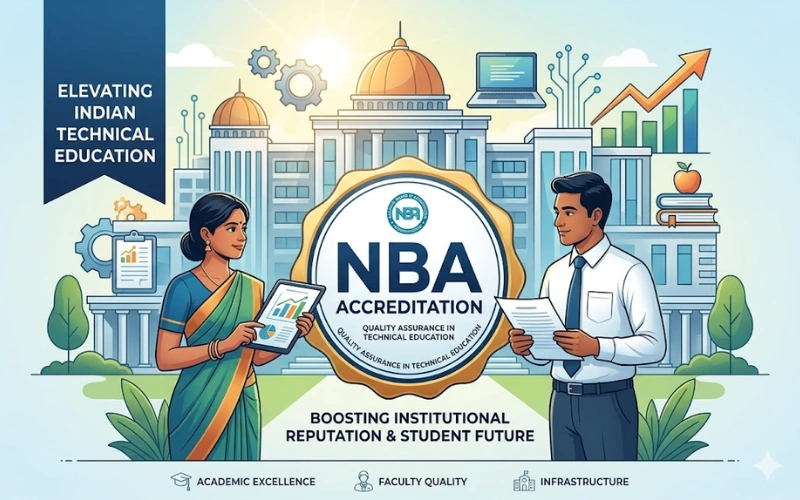
Securing NBA accreditation is a landmark achievement for any technical institution in India. It serves as a seal of quality. It tells students, parents, and the industry that your programs meet global standards.
In the competitive landscape of Indian higher education, staying compliant with the National Board of Accreditation (NBA) is no longer optional. It is a necessity for growth. This Laser Book guide breaks down everything you need to know about the process, the benchmarks, and the best practices for success.
What is NBA Accreditation?
The National Board of Accreditation (NBA) was established to assess the qualitative competence of programs. Unlike NAAC, which evaluates the whole institution, NBA Accreditation focuses on specific programs like Engineering, Pharmacy, and Management.
Why It Matters in India
- Global Recognition: It aligns Indian degrees with the Washington Accord.
- Funding Opportunities: Accredited programs often receive preference for government grants.
- Student Preference: Students prioritize accredited courses for better job prospects.
The Core Pillars of NBA Evaluation
To succeed, institutions must understand the Outcome-Based Education (OBE) model. The NBA Accreditation does not just look at your infrastructure. It looks at what your students actually learn.
Vision and Mission
Your department must have a clear Vision and Mission. These should not just be posters on a wall. They must align with the institution’s goals and involve all stakeholders.
Program Educational Objectives (PEOs)
PEOs describe what graduates are expected to attain within a few years of graduation. They are broad statements that highlight career and professional accomplishments.
Program Outcomes (POs)
POs are narrower. They describe what students should know and be able to do by the time they graduate. For engineering, there are usually 12 defined POs.
Step-by-Step Process for NBA Accreditation
Navigating the NBA accreditation journey requires meticulous planning. Here is a simplified timeline for Indian colleges.
Readiness Review
Before applying, ensure your program has graduated at least two batches. Perform an internal audit. Check if you meet the “Essentialities” defined by the NBA.
Registration and Fee Payment
Register on the NBA Accreditation portal. Pay the required fees for the programs you wish to get accredited. This initiates the formal process.
Self-Assessment Report (SAR)
The SAR is the most critical document. It is a comprehensive report where you provide data against various criteria. Accuracy here is paramount.
The Peer Team Visit
A team of experts will visit your campus. They will verify the data in your SAR. They will talk to students, faculty, alumni, and employers.
Key Criteria for Success (The 1000-Point Scale)
The NBA Accreditation evaluates programs based on a 1000-point system. Understanding the weightage helps you prioritize your efforts.
| Criterion | Key Focus Area | Weightage (Approx) |
| Criterion 1 | Vision, Mission, and PEOs | 50 Points |
| Criterion 2 | Program Curriculum and Teaching | 100 Points |
| Criterion 3 | Course Outcomes and POs | 175 Points |
| Criterion 4 | Students’ Performance | 150 Points |
| Criterion 5 | Faculty Information and Contributions | 200 Points |
| Criterion 6 | Facilities and Technical Support | 80 Points |
| Criterion 7 | Continuous Improvement | 75 Points |
| Criterion 8 | First-Year Academics | 50 Points |
| Criterion 9 | Student Support Systems | 50 Points |
| Criterion 10 | Governance and Institutional Support | 70 Points |
See also: Major League Soccer Players: Top Stars at Laser Book
Best Practices for a Strong SAR
Writing a Self-Assessment Report is an art. Here are some tips to ensure your SAR stands out.
Focus on Evidence
Do not just claim excellence. Prove it. Keep files ready for every claim. If you say you have an industry tie-up, show the signed MoU and the list of benefited students.
Use Data Visualization
Tables and charts make your SAR readable. They help the evaluators understand trends quickly. For example, show the improvement in placement percentages over five years using a bar graph.
Mapping COs to POs
This is where most institutions struggle. Ensure your Course Outcomes (COs) are mapped effectively to Program Outcomes (POs). Use a clear matrix. Avoid “over-mapping” where every course claims to meet every outcome.
Improving Faculty Contributions
Faculty members are the backbone of the NBA accreditation process. The NBA looks for more than just teaching.
- Research and Publications: Encourage faculty to publish in Scopus or Web of Science indexed journals.
- Ph.D. Qualifications: A higher percentage of Ph.D. holders improves your score significantly.
- Consultancy Projects: Faculty should engage with the industry to solve real-world problems.
- FDP Participation: Regular Faculty Development Programs keep the staff updated with modern pedagogy.
Student Performance and Support
The ultimate goal of education is student success. The NBA Accreditation tracks several metrics here.
Success Rate
How many students clear the course in the stipulated time? High backlogs can hurt your score.
Placement and Higher Studies
Where are your students going? Maintain a database of offer letters and admission letters for higher studies (GATE, GRE, CAT).
Entrepreneurship
Does your college have an incubation center? Highlight any startups founded by your students. This shows a culture of innovation.
Infrastructure and Learning Resources
While the focus is on outcomes, you still need the right tools.
- Laboratories: Ensure all labs are equipped beyond the minimum syllabus requirements.
- Library: Digital resources are just as important as physical books. Subscriptions to IEEE, ASME, or similar journals are vital.
- Safety Measures: Check for fire safety, first aid, and accessible ramps for differently-abled students.
The Importance of Continuous Improvement
The NBA Accreditation loves to see a “Closing the Loop” approach. If your students performed poorly in a specific outcome last year, what did you do to fix it?
- Identify the Gap: Analyze the results.
- Take Action: Introduce bridge courses, guest lectures, or new lab equipment.
- Measure Again: See if the performance improved in the next cycle.
Common Challenges in the Indian Context
Many Indian colleges face specific hurdles during the NBA accreditation process.
Documentation Overload
Maintaining records for hundreds of students and dozens of faculty members is hard. We recommend using an Education ERP (Enterprise Resource Planning) system to automate data collection.
Faculty Retention
High faculty turnover can reset your progress. The NBA looks at the average stay of faculty members. Aim for a stable core team.
Industry Gap
Bridging the gap between the syllabus and industry needs is tough. Regular Board of Studies (BoS) meetings with industry experts can help.
Conclusion
Achieving NBA accreditation is a marathon, not a sprint. It requires a culture shift within the institution. It moves the focus from “teaching” to “learning.”
By following these best practices, Indian institutions can not only secure accreditation but also genuinely improve the quality of education they provide. At Laser Book, we believe in the power of structured growth and excellence. Start your journey today by auditing your current processes and building a roadmap for the future.